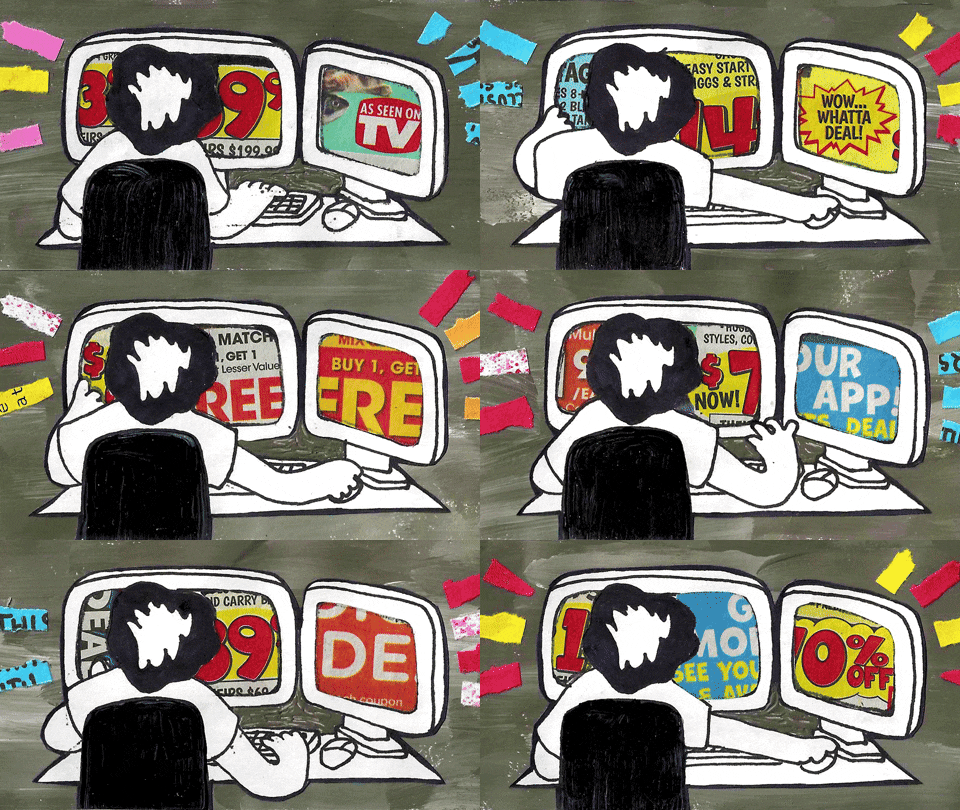
“The new default isn’t disbelief. It’s disengagement.”
a 2026 reality check
The 2026 Content Stack
How to stay visible when the internet summarizes you, copies you, and scrolls past you
If it feels like your best work is getting quieter results, you’re not imagining it. The internet didn’t suddenly become hostile to quality; it became better at compressing, remixing, and skipping. Search is increasingly an answer layer first and a click layer second, social is increasingly a place people watch more than they participate, and the flood of “technically fine” content is quietly pushing audiences into a low-trust posture where everything feels provisional.
In 2026, digital marketing is being rebuilt around three connected shifts that reinforce each other: Generative Engine Optimization (GEO), digital provenance and watermarking, and the social fatigue reset. Each solves a different problem, but together they form a single question: can your content be found, trusted, and enjoyed after it has been compressed, copied, and stripped of context?
What Changed
Discovery became conversational, credibility became fragile, and attention became expensive.
For years, SEO meant fighting for page one. Now the battleground is the overview, the snapshot, the generated answer that appears before a click even happens. Google describes AI Overviews as AI-generated summaries with links to explore deeper, and it has separate guidance for site owners on how AI features intersect with publishing. If you want the clearest mental model for what’s happening, treat your content like it will be summarized by default, because in many interfaces it already is. This is the same underlying pressure I wrote about in Slop, where the real damage isn’t always deception, but saturation and sameness.
At the same time, the internet is being flooded with content that “works” mechanically but fails to land emotionally. It reads smooth, looks polished, and disappears instantly from memory. That’s why the appetite for things that feel authored is coming back, and it overlaps with a broader shift toward owning your distribution and reducing dependence on rented platforms, which I dug into in Owned. When credibility gets expensive, the channels you control start to matter more.
Then there’s the human part. Platforms are still busy, but participation energy has changed, and that changes what succeeds. People aren’t necessarily skeptical in a forensic way; they’re avoidant in an exhaustion way. They scroll faster, skip more, and engage only when something feels worth the cognitive cost. That dynamic sits right on top of the tension in Paradox, because the pressure to stay visible is real, but audiences are increasingly allergic to anything that feels performative or synthetic.
1) GEO
Optimize for the answer, not just the ranking.
GEO is the successor mindset to SEO, not because SEO is dead, but because discovery changed shape. You are no longer only competing for a position in a list; you are competing to become a source that gets pulled into generated summaries. The term “Generative Engine Optimization” was formalized in the paper GEO: Generative Engine Optimization, which frames generative search as a synthesis engine that changes visibility dynamics for publishers and brands. In other words, the goal is not only to be found, but to be quotable.
The practical requirement is that your content must survive summarization. That means the first paragraph carries the core claim instead of warming up, your definitions are crisp enough to travel intact, and your examples anchor meaning so shortened versions don’t drift. If you want a simple way to operationalize this, write like you’re building a toolbox for your future self: clear structure, clean definitions, and no hidden thesis. That overlaps directly with the writing discipline in Toolbox, where the goal isn’t to sound clever, but to make your ideas transportable without breaking.
If you do this well, you don’t just get traffic; you get cited, and being cited is the new visibility premium.
2) Provenance and Watermarking
Invisible signatures in a copy-paste world.
Attribution is fragile now. A screenshot removes a caption, a repost strips context, and edits travel faster than corrections. Provenance is the response: a chain-of-custody approach for media that helps answer who made this, what changed, and what the original is. The core standard effort here is the Coalition for Content Provenance and Authenticity (C2PA), and the technical backbone lives in the official C2PA specification, which is increasingly being adopted across tools and platforms.
In practical creator terms, provenance is less about policy and more about receipts. Keep source files and drafts. Show a process moment. Standardize exports. Treat proof as part of the deliverable, not a marketing afterthought. If you’re building a content engine around a book, a product, or a service, this becomes even more important because your reputation will travel faster than your explanations. That’s one reason I like pairing provenance habits with distribution habits, because reach without attribution is a slow leak, and this is exactly the “how do I get seen without drowning in posting” tension that shows up in Distribution.
3) The Social Fatigue Reset
Less posting, higher standards, and a bigger penalty for filler.
Social platforms are still busy, but participation energy has shifted, and that changes what wins. People are more likely to consume passively and less likely to reward content that feels like it exists because a schedule demanded it. This is also why “vibe coding” and “vibe content” rise and fall so fast: if you rely too heavily on generative systems without taste and verification, you can ship a lot and still build nothing durable. The developer version of this is captured neatly in Coding, where AI acts like an amplifier and the difference between craft and autopilot becomes obvious over time.
The pivot that works is intentional entertainment, meaning content that earns attention because it has taste, clarity, and a point of view. A simple system is to rotate between proof content (work, results, behind-the-scenes, before/after), play content (sharp observations and tiny narratives that feel true), and pull content (clear offers that explain who you help and how to start). This reduces panic-posting and raises signal consistency, which is what fatigue-era audiences actually reward.
The Combined Strategy
Findable. Verifiable. Watchable.
These shifts are not separate trends; they are one reality from three angles. GEO makes you findable inside generated answers. Provenance and watermarking make you verifiable when your work travels without you. Fatigue-aware strategy makes you watchable when attention is expensive. The north star for 2026 is to make content that can be summarized without being distorted, shared without losing its author, and consumed without feeling like a chore, because the interface will compress you whether you like it or not.
References
- Google Search Help: AI Overviews
- Google Search Central: AI features and your website
- arXiv (2023): GEO: Generative Engine Optimization
- Pew Research Center (2025): Americans’ Social Media Use 2025
- C2PA: Coalition for Content Provenance and Authenticity
- C2PA Spec: Specification
- Adobe: Content Credentials overview
- Content Credentials: About and Verify
- DeepMind: SynthID