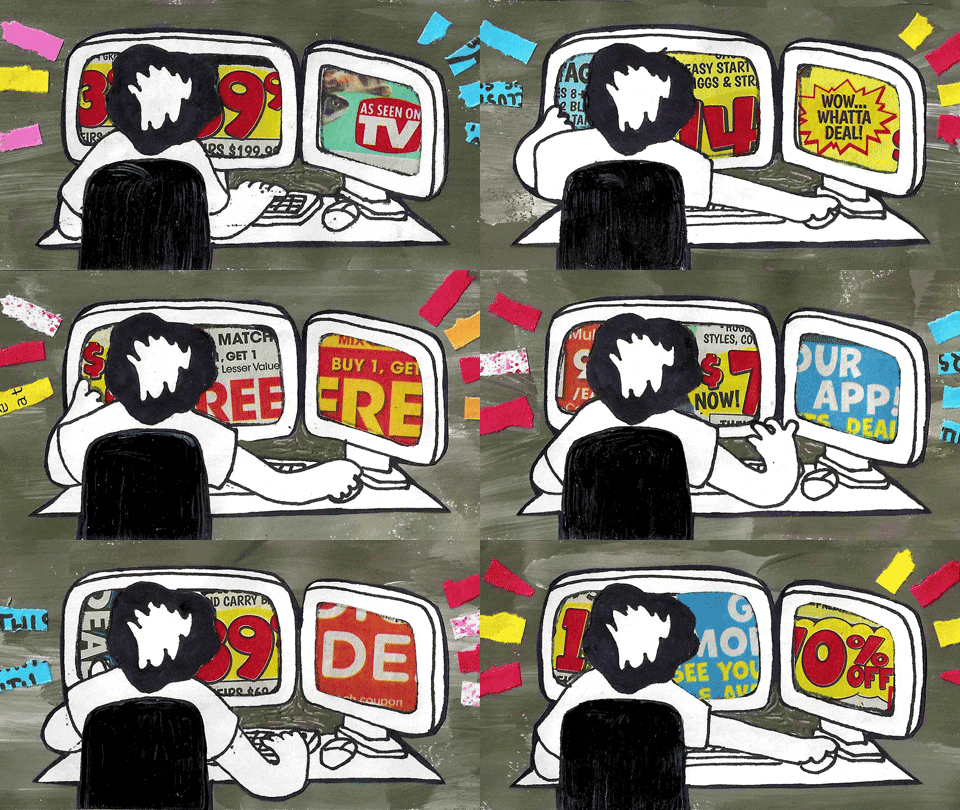
“We don’t want to talk to software anymore. We want it to do the chores.”
The quiet mood shift behind the agent boom
The Year of the Agents
Why 2026 is the year the AI agent replaces the “chat” interface
Chatbots had a good run. They were our first mainstream encounter with “magic” AI, and for a while, they were genuinely thrilling. You could ask for a recipe, a summary, or a poem in the style of a 1940s noir novelist, and it would respond with polite competence.
Then the inevitable happened: competence at scale became boring. The models kept improving, but the interaction pattern stayed stagnant. You ask, it answers, and you still do the work. That “technically good” but emotionally flat experience is now showing up everywhere, from marketing copy to search snippets, and it’s part of the broader AI slop problem, where the sheer volume of “good enough” output makes people quietly tune out instead of loudly complaining.
In 2026, “boring” is no longer a critique. It’s a product requirement. People aren’t looking for better conversation, they’re looking for less effort. The question has shifted from “Can it respond?” to “Can it take action?” This is the migration from read-only to read-write AI, and it’s why “agents” are suddenly the main character. Gartner has been explicit about this direction, predicting that 40% of enterprise applications will feature task-specific AI agents by 2026, which isn’t a feature update, it’s a platform shift that feels closer to desktop-to-mobile than a normal product cycle.
The Hook
Everyone is bored of chatbots because “chat” is not the job.
Most people don’t want a digital pen pal. They want friction removed. They want the bills paid, the calendar triaged, the recurring admin handled, and the boring loops closed without seventeen clarifying questions. The chatbot era trained us to ask, but it didn’t change the fact that the human was still the primary laborer. You can feel this same “enough already” mood in other corners of the internet too, including the quiet rebellion against the subscription economy, where people are shifting toward things they can actually control and keep, rather than endless rented dependencies, which is the underlying theme in Owned.
This also creates a tension creators know well: you want to be seen, but you don’t want to become a content machine. The pressure to post, perform, and keep up doesn’t disappear, but audiences are increasingly allergic to anything that feels automated or hollow. That’s the same knot explored in Paradox, and it’s why “do the chores” is such a powerful promise. It doesn’t just save time. It reduces the feeling of being trapped in an interface that constantly asks for attention.
The Definition
A chatbot gives you an answer. An agent gets the thing done.
A chatbot is a high-bandwidth interface to information. You ask for a template, it gives you a template. That’s advice. An AI agent is a workflow engine. It operates in loops: it observes a goal, decides on a path, executes an action, checks the result, and iterates until the task is complete or it hits a boundary where you need to decide.
This isn’t theoretical anymore. The infrastructure is being built explicitly for it. OpenAI’s developer guidance frames agents as systems that can use tools, keep state, and take multi-step actions, and their guidance on tools explains how models can call functions to interact with real systems rather than only generating text. This is the same evolution we’re seeing in writing workflows too, where the goal is no longer “generate a draft,” but “build a system that consistently produces something useful,” which is the direction mapped out in Toolbox.
Use Cases
Agentic workflows are boring on purpose, and that’s why they’ll win.
The best agents won’t be flashy. They’ll be invisible. They’ll feel like the background hum of a life made smoother, and the biggest compliment they’ll get is that you stop thinking about them.
The Inbox Sentry monitors key threads, drafts replies in your tone, flags anything sensitive, and queues messages for a single approval step before sending. The Logistics Lead coordinates across calendars, proposes options, sends invites, and pre-fills the brief so the meeting starts with context instead of confusion. The Research Engine watches your niche, filters signal from noise, compiles sources, and produces a publication-ready brief while you sleep, which is especially useful if you’re trying to build a long-term distribution machine instead of random spikes, the same goal behind Distribution.
For developers, this changes the stakes. It’s no longer about who can prompt the best. It’s about who can design the safest, cleanest system around the model. AI acts like an amplifier: good engineers get faster and sharper, and sloppy engineering gets louder. That’s why “vibe coding” is both exciting and dangerous, and why guardrails matter more than vibes, as explored in Coding.
The Trust Hurdle
Giving AI the agency to act is powerful, which is exactly why it’s dangerous.
This is where the hype hits a wall. Agents aren’t just smarter chatbots. They are software with the ability to act in real environments. A chatbot can give you a wrong fact. An agent can send the wrong email, leak data, delete files, or authorize a payment that shouldn’t happen. We move from “bad answer risk” to “operational risk,” and that’s an entirely different category of responsibility.
The industry response is a “human-in-the-loop” architecture, but the important part isn’t the phrase, it’s the discipline. Trust has to be engineered rather than assumed. The winning agents won’t be the ones that act with total independence, but the ones that provide proof of what they intend to do, show what they did, log everything, and stop at the exact boundary where a human judgment call is required. This is the same principle that separates content that feels authored from content that feels assembled, and why systems that preserve intent and accountability are going to matter more as AI becomes more capable.
Conclusion
By 2027, “chatting with AI” will feel like using a landline.
Chat won’t vanish, but it will become the fallback interface, not the primary one. Our default expectation of technology is shifting from “Tell me” to “Do it.” The products that survive won’t be the ones with the most personality. They’ll be the ones with the most reliability, the clearest permissions, and the safest boundaries.
The brands and creators who thrive in this era won’t just ship content. They’ll ship systems of trust, and they’ll use AI the same way the best teams use any powerful tool: with intention, guardrails, and accountability.
References
- Gartner (2025): 40% of Enterprise Applications Will Feature Task-Specific AI Agents by 2026
- OpenAI Platform: Agents Guide
- OpenAI Platform: Tools Guide
- McKinsey & Company (2023): The Economic Potential of Generative AI
- Stanford HAI (2024): AI Index Report
- Microsoft Work Trend Index (2023): Will AI Fix Work?
- Anthropic (2024): Constitutional AI & Safety Research
- NIST (2023): AI Risk Management Framework